AI Development | Technology Consulting Company Australia

Address: Perth, WA
Email: hello@avenuegroupaus.com.au
Phone: 0400-082-072

Blog
AI in Smart
Homes: 2026 Guide to Automation, Security & Energy Savings
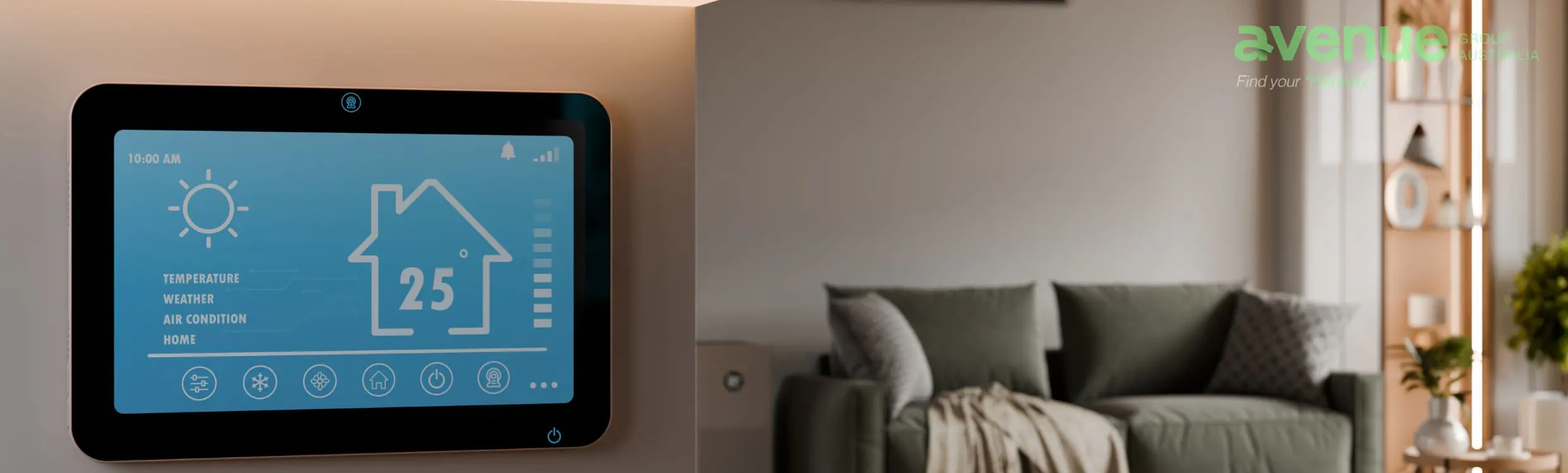
Artificial Intelligence is transforming multiple aspects of the tech ecosystem, from a remarkable presence in the tech ecosystem to including making homes smarter and safer. This technology is so deeply woven into our everyday lives that it is slowly and silently transforming our routine.
The integration of AI in software development has resulted in a tech revolution; similarly, AI in smart homes is transforming how we live. Homeowners are increasingly installing AI-powered devices and systems for automating several household tasks with a single command or touch and enhancing security.
- ➔ According to Statista reports, the global smart home market in Australia is expected to reach over 4.5 billion U.S. dollars in 2026.
- ➔ By the end of 2026, the number of active smart households in Australia is expected to reach 7.8 million users.
- ➔ AI overviews appear in search of nearly 60% of smart home product queries on Google.
Why do you think the prominence of voice assistants like Amazon Alexa and Google Assistant is accelerating?
It's because the AI algorithms in these smart devices generate real-time insights from the usage patterns and then perform tasks accordingly. They also provide recommendations for improving efficiency in energy usage. In this way, AI is enhancing the living standards with advanced automation, making life easier, secure, and more efficient.
Let's look at this integration in more depth in this article, uncovering:
- ➔ Benefits
- ➔ Real use cases
- ➔ Challenges and mitigations
- ➔ Cost vs ROI comparison
- ➔ The future trends
- ➔ Observing user routines and understanding their preferences. For instance, analysing when you would like a certain temperature or lighting and adjusting it automatically.
- ➔ Voice recognition and natural language processing help them understand user accents, mood, and speech. The best example to understand the magic of voice commands is Amazon Alexa.
- ➔ AI can predict maintenance, providing timely alerts and scheduling maintenance if needed.
- ➔ Based on user behaviour and weather conditions, AI optimises energy use, delivering significant savings. This includes AI-assisted thermostats that automatically adjust indoor temperature based on your daily patterns and outdoor conditions.
- ➔ AI detects the sunlight and reduces or brightens the interior lighting to provide comfort to your eyes. It also offers mood-based lighting without any manual intervention based on your activities, such as reading, cooking, sleeping, etc.
- ➔ Your air purifiers can also become highly functional with AI in smart homes. AI monitors the indoor air quality and then adjusts the purifiers to maintain a healthy environment. This also means you can have AI synchronise your ventilation systems by ensuring fresh air when you are home and turning on energy-saving mode when you are not.
- ➔ AI-powered cameras that can detect and alert you in real-time about suspicious activities or movements surrounding your property.
- ➔ Smart AI devices activate sirens to send a signal to the homeowners and resist unauthorised access to your property.
- ➔ With voice, face, or fingerprint-enabled devices, AI can ensure the perfect security lock for the main door of your home.
- ➔ The remote access alerts the owner when there is a security breach and gives them complete control over the security.
- ➔ Smart refrigerators can track the inventory and suggest a grocery list based on the low-running items.
- ➔ Based on your recipe, AI ovens can automatically adjust to cooking.
- ➔ Living rooms are no longer static, as AI transforms them when someone walks in. AI recognises individual movement and adjusts lighting, music, and other ambience to suit the personal preferences.
- ➔ AI robot vacuums can automatically create maps and clean your home with a simple ‘start’ command from the mobile application.
- ➔ Detect and optimise your washing machines before they stop working based on the washing patterns. They give notifications on your mobile device to clean the drum if it’s choked with dirt.
- ➔ If your dishwasher or refrigerator is taking longer than usual and consuming more power, the system will alert the owner and suggest usage changes.
- ➔ Custom AI solution development to connect devices and systems for smart decision-making in real time.
- ➔ Smart automation and workflow integration reduce manual intervention.
- ➔ End-to-end support to enhance system responsiveness.
Benefits of AI in Smart Homes
AI-assisted smart home products use advanced automation to manage home appliances and facilitate smart and secure homes. AI in smart homes provides an intuitive way to access and control different home functions. The preset commands of traditional automation have been conveniently replaced with AI-enabled smart home devices that adapt in real-time. AI personalises smart homes by:
Some benefits of integrating AI in smart homes include:
1. Smart automation
By understanding and tracking your daily habits, preferences, and activities, AI automates tasks and home appliances.
2. Enhanced accessibility
AI has smart algorithms that can detect the voice of the users and perform actions based on the voice commands. Voice-enabled home devices offer complete assistance to easily operate the device with optimal comfort. These systems enable hands-free operation by just using your voice to operate everything.
3. Enhanced security
In addition to convenience, AI also fosters security with AI-powered devices that can detect potential data breaches and changes in user behaviour patterns. This assists users in ensuring maximum protection by connecting AI in smart homes with other systems, such as surveillance cameras, alarm systems, etc.
AI Use Cases in Smart Homes
Gone are the days when the demand to hire AI developers was only to facilitate advanced software development. Times have changed, and with that, the application of AI has evolved and expanded to distinct industry verticals.
From refrigerators, washing machines, to robots and cameras, AI is empowering several home operations. AI is reshaping smart homes with adaptive, responsive, and personalised experiences. Based on real-time data analysis, these devices make thoughtful suggestions and adjustments in your daily routine.
Let's look at some of the top-rated applications of AI in smart home devices:
(1) AI in Home Automation
Besides the tech landscape, the first big leap that AI made towards smart living was with home automation. AI in smart homes evolves into intuitive living with the following benefits:
(2) AI in Home Security
AI can strengthen your home security systems with advanced technologies to offer you peace of mind. Some common roles to justify this include:
(3) AI in Smart Kitchens and Living Spaces
AI in smart homes can make your kitchen and living areas more dynamic and responsive by going beyond light and temperature control.
(4) AI in Predictive Maintenance
Another practical benefit of AI in smart homes is the ability to track and schedule maintenance before they become an obstacle in appliance operations. Based on pattern recognition and sensor data, these systems can avoid costly failures.
Challenges and Solutions: Leveraging AI in Smart Homes
While the application prospects of AI are enticing, they do have integration challenges that can be potential drawbacks. Every technology comes with limitations, and AI is no different.
There are a few gaps that can act as potential red flags and need to be addressed to ensure reliability and security. Some of the most common challenges include:
1. System failure
Electronic devices are at the highest risk of system failures due to errors or bugs in coding. System failures can hamper the user's trust and result in inconvenience. Sustainability can be the biggest challenge with AI in smart home devices.
Mitigation Strategy
Partner with Avenue Group Australia, an AI development company in Melbourne that can ensure efficient usage with less power consumption and improved process efficiency.
2. Data privacy and security
While daily tracking and control are a boon, they can also be a bane for the users. Users might have concerns about the confidentiality of their private and sensitive data. Each piece of your activity and data is being recorded and monitored, making data privacy another big challenge.
Mitigation Strategy
Use strong passwords, multi-factor authentication and encryption protocols, and update the smart home devices with the latest security patches.
3. Inaccurate predictions
If humans can make mistakes, AI is merely a technology. While AI learns and improves, it’s still prone to errors. For instance, if there is a guest in the house, a new user detection can confuse the system and trigger unnecessary alerts.
Mitigation Strategy
Implementing a multi-modal AI verification system can be a smart tactic to deal with this integration challenge of AI in smart homes. This means when there is a new user, AI will wait for secondary information like door sensor activation before acting on the single input.
4. Limited contextual understanding
AI tools act based on their analysis of user patterns. This means that if there is the slightest change in real-time, it can lead to misinterpretations. For instance, AI might not know if you are feeling feverish, and it might just increase the temperature like usual without knowing the change in your routine.
Mitigation Strategy
A smart way to mitigate this challenge can be to keep human feedback in the loop. Don't confuse AI as a replacement for human intelligence and understanding. It's there to simplify your tasks but not to eliminate your role.
5. Regulatory uncertainty
As the evolution of AI in smart homes has gained prominence globally, new laws keep emerging for data privacy, facial recognition, etc.
Mitigation Strategy
Stay compliant with these evolving regulations and update your AI devices accordingly to avoid costly complications in the future.
Future of AI in Smart Homes
The next wave of smart home adoption is expected to be driven by AI advancements, robust security measures, and improved device interoperability. Personalisation of AI in smart homes is expected to further simplify with emerging technologies like IoT, cloud computing, 5G, edge computing, etc.
The profound impact of AI in everyday life is just the beginning; it’s all set to revolutionise the way we live. The endless possibilities will keep expanding as the popularity and accessibility of AI and smart homes continue to grow.
If you are looking to leverage AI in smart homes, Avenue Group Australia can be the right expert you need. As a leading AI development company in Melbourne, they help individuals and businesses bring their smart home vision to life. From strategising to optimising, hiring AI developers from Avenue can offer:
Your Roadmap to Integrate AI in Smart Homes
AI-powered smart home devices are becoming a convenient and powerful option for homeowners to control their homes. Using AI and ML algorithms, these devices are known for their real-time notifications and advanced security.
The potential of AI in smart homes in Australia is sure to keep growing in the years to come. It’s a successful rollout that is deeply embedded in most smart homes in Australia and is expected to have an increasing market revenue.